Middle School

6th-8th Grade

Growing in Academic Responsibility & Independence

West Hills Christian School’s middle school program builds on the concepts and skill sets learned in elementary school and seeks to deepen and widen students’ critical thinking and perspective. Students are instructed by supportive teachers who sharpen their minds, guide them as they shape their identities, and help them grow their relationships with God and one another. The middle school years mark a transition where we students become more self-directed learners, taking on greater responsibility and embracing leadership roles.

Within the middle school program, students participate in daily core subjects, regular PE classes, twice-weekly electives (STEM, Art or Music), and weekly chapel. Intentional class sizes, high-level instruction, and thought-provoking subject matter equip students to succeed academically and transition smoothly to high school.

6th Grade

As our entry grade into middle school, 6th grade at West Hills is a strategic year of transition. Students are taught by two core teachers. Our program is designed to help students continue to grow in their academics, personal responsibility, and spiritual lives, leading to the increased autonomy required in the upper grades.

What 6th-8th Graders Experience at West Hills Christian School

Below is a synopsis of the concepts and subject matter you can expect to be covered in each grade level, including a few examples of the special projects, musical programs, and milestone events unique to each specific grade at West Hills.

Math: Increasing fluency in multiplication, division, fractions, decimals, and ratios. Students are introduced to algebraic concepts, expressions, equations and variables, integers, and rational numbers, and will broaden their understanding of geometry. Class is divided into a regular and accelerated course using the same curriculum.

Social Studies: Students will study the geographical features, government structures, social classes, daily life, history, and important achievements of the ancient civilizations of Mesopotamia, Egypt, Israel, India, China, Persia, Greece, Rome, and others, using Scripture and other primary sources to gain insight into the people and events of long ago. We will also examine different world religions, comparing and contrasting them with Christianity, and learn how God’s people through the ages have spread the Gospel worldwide, bringing God’s truth and the hope of salvation to every tribe, tongue, and nation on the earth.

Language Arts:

  • Reading: Students read a variety of narrative and informational texts, as well as poetry and Scripture, to advance fluency and comprehension skills and students’ ability to discuss and analyze increasingly complex literature. Sixth grade emphasizes understanding of plot elements, literary devices, informational text structures, inferences and textual evidence, central themes, connections to other texts and real life, summarization of main ideas, and academic vocabulary.
  • Writing:  Students write daily, in one sitting or over time, to craft clear, concise, well-developed and grammatically-correct written pieces for a range audiences and purposes, including:
    • reflective journal entries
    • engaging fictional and personal narratives
    • well-supported argument essays
    • clear and concise informational texts to clearly and accurately explain complex ideas, processes, and events
    • thoughtful literary analysis essays to examine thematic elements and character development in novels and short stories
  • Spelling Roots: Students study Greek and Latin word roots and their connections to essential academic vocabulary.
  • Grammar: Students work to hone their skills of capitalization and punctuation and to understand and locate the following parts of speech: prepositions, verbs, nouns, adjectives, adverbs, and pronouns.

Science: Students investigate different facets of science through research and experimentation. In addition to a weekly science lab, teachers work to implement hands-on activities, mini labs, and demonstrations in class. At the 6th grade level, students continue to study a variety of topics in the areas of life, physical, and earth sciences.

Bible: Broad surveys of both Old and New Testaments, including the formation of the Biblical canon, how these scriptures point to Jesus Israel’s Messiah, and how to begin finding our way through the entire narrative of scripture. Additional focus given to introductory Bible themes and tracing such themes through, from Genesis to Revelation.

Unique milestones: Outdoor School

7th grade:

  • Literature focus on short stories, poetry, and book studies
  • Writing strengthened through the study of various genres
  • Exercising vocabulary using Greek and Latin roots; strengthening spelling, word relationships and comprehension

8th grade:

  • Literature focus on cultural awareness and “classic” authors through book studies, short stories, and poetry
  • Writing honed through research utilizing the MLA style and the study of persuasion using great American speeches
  • Building on vocabulary of Greek and Latin roots to continue to strengthen spelling, contextual vocabulary relationships, and vocabulary familiarity

7th grade:

  • History of the World: Ancient history from Ancient Rome through World War I. 7th grade World History will also include a study of concepts of heritage, justice, and citizenship.

8th grade:

  • History of the United States: History from the early colonies through World War II covering key turning points in preparation for a trip to New York and D.C. at the end of the year. 8th grade US History will also include a focus on the U.S. Constitution, change and continuity over time as well as regular discussions involving contemporary issues.

Placement determined by ability rather than grade level

7th grade:

  • 7th Grade Math: Focus on performing operations with rational numbers; introduce writing, manipulating, and solving algebraic expressions, equations, and inequalities; application of ratios, proportions, and percents; growth in calculating probability and statistics, and expand knowledge of geometric calculations. 
  • 7th Grade Pre-Algebra: Focus on performing operations with rational numbers; introduce writing, manipulating, and solving algebraic expressions, equations, and inequalities; application of ratios, proportions, and percents; growth in calculating probability and statistics, expand knowledge of geometric calculations; introduce transformations in the coordinate plane; and introduce manipulation of numbers using scientific notation. 

8th grade:

  • 8th Grade Pre-Algebra: Expand skills in writing, graphing, and solving algebraic equations; expand knowledge of geometric calculations; continue practice with displaying and interpreting data, introduce transformations in the coordinate plane; and introduce manipulation of numbers using scientific notation. 
  • 8th Grade Algebra 1: Focus on writing, transforming, graphing, and solving linear, exponential, quadratic, and radical functions. Continue practice with displaying and interpreting data.

7th grade: 

  • Life Science: Study of living things (microorganisms, fungi, plants, and animals), genetics, and ecology. Weekly hands-on experience in the Lab that relates to the content, incorporating the use of microscopes, dissections, and other experiments.

8th grade: 

  • Earth Science: Study of earth (its structure and the processes that shape it), space (sun, planets, moons, and their relationships), and experimental design. Weekly hands-on experience in the Lab that relates to the content.

7th grade:

  • Grammar I: Identifying parts of speech and their functions; applying correct grammar to formal writing and speaking

8th grade:

  • Grammar II: Applying standard grammar and usage in speaking and writing; identifying types of phrases, clauses, and cases

7th grade:

  • Broad study of the establishment of the Family of God in Israel, the life of Christ, and the Family of God in the Church, working through both Old and New Testaments. Particular focus on the Abrahamic Covenant and God’s promises within, and the New Covenant established by Jesus and respective promises within.

8th grade:

  • Intimate study of ‘pillar’ characters throughout the Old and New Testaments, focusing on how the entirety of scripture develops the portrait of Jesus as Israel’s Messiah and God become human. Particular focus on the identity of Jesus as represented by the four Gospel portraits, along with New Testament characters’ responses to Jesus as such.

7th grade:

  • 7th/8th grade retreat; trip to a Pacific Northwest landmark; participation in electives.

8th grade:

  • 7th/8th grade retreat; Proverbs Project; Inquiry Project; participation in electives; trip to Washington, D.C. and New York City; 8th grade “clap-out” tradition (all students line the halls on the 8th graders’ last day of school to applaud them as they leave the building one final time); Graduation Ceremony.
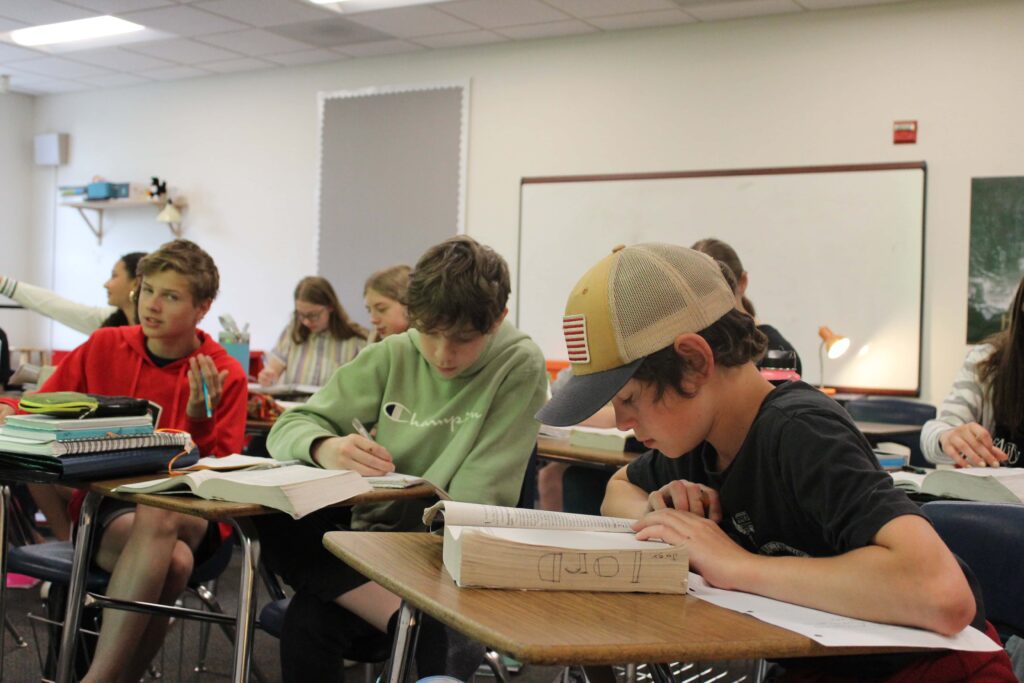
Middle school boys read their Bibles in the classroom.

Faculty

Smiling woman with long brown hair and a floral necklace against a gray background.

Kate Lyon

7th/8th Grade Teacher & Communications

Knight helmet logo on a shield, possibly for Kate Lyon's blog

Jared Pratt

7th/8th Grade Teacher

Brynna Wallace portrait, smiling with long brown hair against a gray background.

Brynna Wallace

7th/8th Grade Teacher

Notice of Nondiscriminatory Policy as to Students

West Hills Christian School admits students of any race, color, and national or ethnic origin to all the rights, privileges, programs, and activities generally accorded or made available to students at the school. It does not discriminate on the basis of race, color, and national or ethnic origin in administration of its educational policies, admissions policies, scholarship and loan programs, and athletic and other school-administered programs.